
 |
| Liberal Women Protest March I” (1995) by Nigeria's Nike Davies-Okundaye, gift to Smithsonian by Ambassador Robin Renee Sanders from her collection |
 |
| Chief Nike explaining her work at the
Smithsonian
|
Chief Nike Davies-Okundaye is one of Nigeria's leading cultural icons - a painter, sculptor, teacher-trainer of the arts, supporter of women, and preserver of Nigerian traditional cultural practices. It is in this light and to ensure well-deserved recognition that Ambassador (Dr.) Robin Renee Sanders gifted two of Davies-Okundaye's painting series from her collection to the prestigious Smithsonian Museum of African Art. The painting series by Davies-Okundaye is entitled Liberal Women Protest March Parts I & II -- showcasing the strength and resilience of Africa's women. In sum the piece represents the Collective Power of Africa's women (be they on the Continent now, or currently or historically part of the Diaspora).
 |
| Ambassador Sanders at Smithsonian in front her donation of Nike's work |
Chief Okundaye's paintings are now not only part of the Museum's permanent collection, but are two of the leading pieces at the beginning of the NMAA's newest exhibit called "I Am...Contemporary Women Artists from Africa," which has been receiving rave reviews from leading newspapers across America such as the Washington Post. Sanders, the former United States Ambassador to Nigeria, who herself is a collector of African Art and a philanthropist focused on the arts and African
education, gifted the pieces to the Smithsonian to ensure that the works of Chief Okundaye, who she fondly calls "Mama Nike," were seen not only by more Americans, but further on an international stage.
Sanders and Okundaye, first met by chance more than 15 years ago long before the former became U.S. Ambassador to Nigeria. The chance encounter centered around Nigeria traditional textiles, of which Sanders is known to wear and also collect. What makes the brief encounter more than 15 years ago so significant is Chief Nike telling Sanders then that she "would return someday to Nigeria as the U.S. Ambassador" -- and so, as fate would have it, it came to be.
 |
| Nike with Ambassador Sanders' father at Okundaye's
Center in Lekke
|
Since then Sanders and Chief Nike families have become family. Nike, her husband Reuben, and their daughters and Sanders' family remain in close communication today. Ambassador Sanders' family also visited Nigeria and Okundaye's cultural centers in Lekke and on the outskirts of Nigeria's capital, Abuja, several years back.
 |
| Nike Davies-Okundaye's work, Liberal
Women Protest March I & II
|
"What I love about Mama Nike," Sanders says, "is that she herself is the living embodiment of art and culture." "When you see her or hear her speak, you feel it... you feel just how alive art is and how much it is a part of you. "When I saw the paintings Liberal Women Protest March I & II; II," Sanders says, "the pieces just spoke to me on so many levels, but most importantly to me they were so Nike!" "Furthermore, the role of art and culture in my life has always been paramount - inherent gifts given to me by my Mom -- who was an avid lover of literature, theater and all things cultural. I inherited all those traits and they not only make me who I am today, but I believe they always made me a better (maybe a different) diplomat as I always sought to understand and respect the culture first before I did anything else.
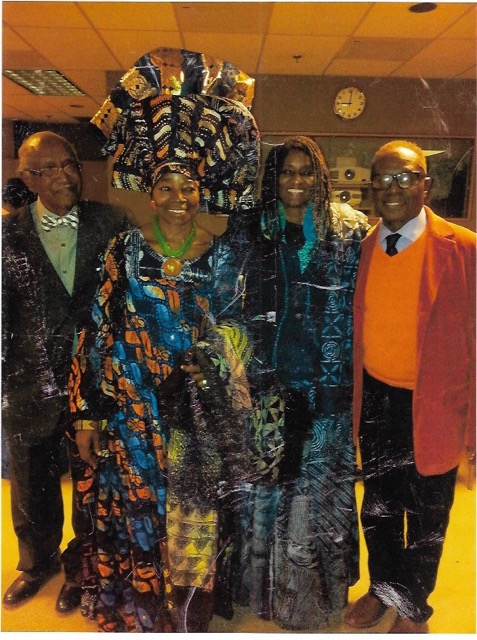 |
| Nike at Smithsonian with Sanders' and her family - Father (l) & cousin Dr. Frazer (r) |
 |
| Plague - Sanders' donation of Nike Davies- Okundaye's work, Liberal Women Protest I & II |
For her part, Nike notes that Sanders was "always a giver of no equal," and her benevolence, says Davies-Okundaye "earned her the unique name 'woman of the people,' while she was the U.S. Ambassador to Nigeria." Chief Nike, DFA, who considers Ambassador Sanders one of her daughters, further explains that Dr. Sanders had always said that her art needed to be exhibited at the Smithsonian, and then promised to make it happen. Thus, exhibiting yet another of Sanders' fundamental characteristics -- being a "woman of her word," comments Okundaye. "Her donation of my work to the Smithsonian has unequivocally helped shine a global limelight not just on me but by extension to all Nigeria artists associated with my Centers," Chief Nike adds. "It is as a result of Robin's efforts, that I have been bestowed this great honor and the privilege of attending and speaking at the exhibit opening to see my work displayed alongside so many other great world artists. This is a singular moment in time which will remain ever-green in my memory throughout the days of my life, and for this I thank her."
Davies-Okundaye's work at the Smithsonian NMAA is not to be missed. Its power is . . . palatable/sapid, its message . . . is unmistakable . . . its strength . . . is undeniable.
A FEEEDS Series BlogSpot
A FEEEDS Series BlogSpot

