Dr. Sanders under an endowment in her late mother's name supports a RMU student to intern at South Africa's famed African Leadership Academy (ALA) to learn about Africa, enabling her to meet other young leaders from the region, and also be able to share more of what Africa is really about dispelling many stereotypes and lack of knowledge about the region in her various communities and elsewhere. Sanders will be supporting a member of her FEEEDS staff to participate in ALA's Model African Union Conference March 2019. See testimonial: https://youtu.be/8iP8iuyUbpA .
A FEEEDS Series BlogSpot

FEEEDS® dialogues & advocates on issues of Food Security, Education, Environment-Energy, Economics, Development-Democracy & Self-help, The FEEEDS Issues. Dr. Robin Sanders, CEO FEEEDS & FE3DS, former U.S. Ambassador to Nigeria, Congo, & ECOWAS. Website:http://www. ambassadorrobinreneesanders.com. FEEEDS ask you to beware of all scam emails/text claiming to be from Amb. Sanders/FEEEDS as funding or monies are never requested. Report scams to FBI at spam@uce.gov
Showing posts with label Africa education. Show all posts
Showing posts with label Africa education. Show all posts
Wednesday, January 30, 2019
Tuesday, July 24, 2018
Dr Sanders Opens Joburg's African Leadership Academy Model African Union Event

South Africa's prestigious African Leadership Academy (ALA),
 one of the best new models of African educational institutions, not only celebrated its 10th anniversary this year but also its 5th Model Africa Union Conference pulling in high school level students from across the African Continent.
Featured keynote speaker and session advisor for this year's prestigious 2018 Model AU conference was Ambassador Sanders who spoke not only about leadership, but also encouraged students to see their ALA education as a form of "power," which no one can ever tale away from them.
In addition to being the opening keynoter, Sanders also provided advice and suggestions in specific issues such as peace and security, conflict resolution, and the prospect of bitcoin used to address various funding challenges of the AU, and held an hour-long diplomatic roundtable with the assembled 200 plus students on today's world issues from Burma-to-Syria-to-Africa and the International Criminal Court.
Sanders also received a recognition award from ALA for her contribution to the conference and students.
 |
Sanders Giving Opening Night Keynote, Below responding to questions during hour long townhall on diplomatic & African Continental issues, and world events. |


Receiving Appreciation Award; Below cultural night where students dress in traditional dress for their countries; Main entrance to ALA


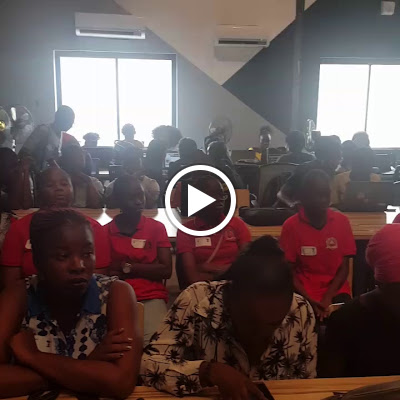
Sanders talks to Young Female Coders in Lagos,Nigeria
 Teams of young high school female coders gather at Lagos, Nigeria's Venture Garden Group (VGG) ICT company's new offices to participate in a coding competition in an effort to encourage girls to see coding as a future area of entrepreneurship. Sanders also sits on the board of VGG.
 Dr. Sanders, an Information Systems and Communications major herself, had an opportunity to talk to the budding ICTers about how important their participation is in the field and encouraging them to see the profession as an sector for their future livelihood.


Friday, July 13, 2018
Friday, February 23, 2018
Ambassador Sanders is TCC College Black History Month Speaker on "The New Global Landscape"
As the keynote speaker for TCC College's "I Will Step Into Greatness," during the 2018 Black History Month program, Ambassador Sanders highlighted the importance of students recognizing that they can be and do anything they set their minds to -- as long as they have a good education! Moreover, she added that it was critical for them to take advantage of their learning experiences at TCC as use those tool to address some of the global challenges in their community, or if so desire, also on the global stage.


Tuesday, March 4, 2014
Ambassador Sanders, CEO FEEEDS Receives Advocacy Impact Award from African Leadership Magazine
Press Release
Washington, D.C. March 2, 2014 – The London-based African Leadership Magazine which focus on identifying and recognizing key leaders in the Diaspora and in Africa who work to advance the positive development, economic, and political goals of the African Continent, honored several leaders at its hallmark Washington, D.C. event. Among those honored was FEEEDS CEO, Ambassador (Dr.) Robin Renee Sanders for her commitment, advocacy, and work with small and medium size entrepreneurs (SMEs) in Africa, Sanders, who previously was the United States Ambassador to Nigeria, and the Republic of Congo has long worked throughout her U.S. diplomatic career and now in the private sector on addressing key economic issues in Africa.
Sanders, who received the Africa Advocacy Impact Award was
honored along with several others that included, Nigeria’ Rivers State
Commissioner for the Private Sector, William Essien of First Capital Plus
Ghana, and A. V. Felix Managing Director and CEO of Energia Limited. Sierra
Leone’s President Dr. Ernest Koroma was honored with the Africa Leadership
Award.
In her remarks in accepting the award, Ambassador Sanders
highlighted that she had committed her life to believing in Africa’s
development and forward progress despite the challenges, and was always an
“Africa-optimist,” way before it became en vogue to do so over the last few
years. She noted her current work with
SMEs, affordable housing and in food security and the environment – key
elements of her FEEEDS Advocacy Initiative – and stressed that leadership was
about vision, transparency, flexibility, implementation, and most of all
humility. Dr. Sanders also received congratulations for receiving the award noting Nigeria's appreciation for her past work and diplomatic service during her tenure in Nigeria from Nigeria's Ambassador to the United States, Professor Ade Adefuye.
Friday, January 17, 2014
Ambassador Sanders at Brookings Institute: Discusses Africa's key Economic Development Areas
As part of a high level panel of Africa experts, Ambassador Sanders highlights her perspective on Africa 2014 and key areas of development -- SMEs, agriculture, ICT, support to the African Diaspora, education, and vocational training -- to address long term wealth creation and improvement in the quality of life for the majority of the African population. Click link to see program:
http://youtu.be/RYEVkrXSoK0
Tuesday, October 15, 2013
FEEEDS @ the World Bank Annual Mtgs: Focus on Financial & Techonology Inclusion
A FEEEDS series:
The FEEEDS Advocacy Initiative participated in a panel for Civil Society organized by Operation Hope during the World Bank Annual Meetings Oct 8-12. Under the FEEEDS umbrella, Dr. Sanders made the following key points highlighting and underscoring that financial inclusion needs to be broader than just providing banking services to the 2.5 billion people in the world who are not connected to the global financial system, or linked via digital technology to be included in services that help them improve their quality of life or enhance their employment or business capabilities-- even in the informal sector.
Hence Dr. Sanders highlighted her view and simplified and broad definition of financial inclusion -- what it should do and a way forward in addressing e-empowerment and global dignity:
Who does financial and technology inclusion address:
For advancing financial and technology inclusion and also addressing the points of: access, education/accessibility, ease of usability? Mobile Phones/Digital Technologies. Why?
They don't address income disparity. Africa, Latin America, Asia, have greatest income disparity, with South Africa reportedly leading the way as the country with the world’s great inequitable income distribution (CCTV-news).
The FEEEDS Advocacy Initiative participated in a panel for Civil Society organized by Operation Hope during the World Bank Annual Meetings Oct 8-12. Under the FEEEDS umbrella, Dr. Sanders made the following key points highlighting and underscoring that financial inclusion needs to be broader than just providing banking services to the 2.5 billion people in the world who are not connected to the global financial system, or linked via digital technology to be included in services that help them improve their quality of life or enhance their employment or business capabilities-- even in the informal sector.
Hence Dr. Sanders highlighted her view and simplified and broad definition of financial inclusion -- what it should do and a way forward in addressing e-empowerment and global dignity:
Financial and Technology Inclusion for FEEEDS
Advocacy Initiative means: Access, Education, Acceptability, Ease of Usability to interact – based
on needs or what one does for a living -- with the global financial system
or via the digital technology world. This is key particularly for rural
areas/at risk urban communities, youth, women, persons with disabilities, and
the elderly.
What does this do:
•
Provides global dignity, empowerment, improved quality
of life, hope, emotional satisfaction
Who does financial and technology inclusion address:
- Initially and globally, the 2.5 billion working age people who are currently excluded & adolescents so they don’t add to the 2.5 billion.
- We need to begin to education adolescents and
teenagers on inclusion early so they do not become part of the cycle of
exclusion and add to the current 2.5 billion currently not connected.
For advancing financial and technology inclusion and also addressing the points of: access, education/accessibility, ease of usability? Mobile Phones/Digital Technologies. Why?
- 1 billion mobile phones in the world in 2000; over 6 billion in 2013, of which nearly 5 billion are in the developing world. Applications or “apps” also have exploded in the last 5 years, with approximately 30 billion "apps“ downloaded in 2011.
- Africa is ahead as most wireless Continent (736 million mobiles by end of 2013, 100 million in Nigeria), China nearly 8 million & India 7 million new mobile phone users per month.
They don't address income disparity. Africa, Latin America, Asia, have greatest income disparity, with South Africa reportedly leading the way as the country with the world’s great inequitable income distribution (CCTV-news).
Why is financial & technology inclusion as
game changers important?
According to a 2005 London Business School Report
– in addition to improving quality of life when 10 people out of 100 use a
mobile phone GDP rises about .59 percent.
Financial and technology inclusion also has to
come with job creation and entrepreneurship development in order to reach true
global dignity as it is defined by Operation Hope.
Saturday, April 28, 2012
Reframing Africa:2012 & Beyond: Africa's Value-Chain Contributions to the Global Community -The Positives, Challenges & Way Forward
A FEEEDS Series
By
I have entitled my remarks today “Reframing Africa,” meaning talking about the region differently, and respecting its multifaceted dimensions. I would like to begin with what I think of as Africa’s value-chain contribution to both the Continent and the global community -- using the phrase "value chain" in an atypical manner -- meaning whatever progress each and every African country makes going forward has a positive ripple affect Continent-wide and for the global community writ large.
In fact, I have been urging (through my blog) that we re-coin the term BRICS which focuses on the economic prowess and growth rates of Brazil, Russian, India, China and in Africa only South Africa (currently with a projected 3.2% growth rate for 2012 according to World Bank reports) to BRICA in order to be more inclusive of the success and influence of other African nations that are enjoying positive growth rates at 5% or more over the last 3 years. There is a wave of economic growth and development for Africa’s emerging markets at a time of global economic downturn or slow recoveries in Europe, in the U.S. and elsewhere. On top of this, the average 2012 projected collective growth rate for SSAfrica is hovering between 6-7%, with the Financial Times forecasting this to be on order for the region over the next 20 years (http://tinyurl.com/FT-Africa-Rising).
Equity and institutional investors are increasingly seeing the region as a haven for investment and a range of new Africa-focused equity funds are cropping up everywhere on business, infrastructure, ICT, agriculture, health or with a Diasporan focus like Homestrings (https://www.homestrings.com). The importance of the African Diaspora being involved in the Continent’s economic growth cannot be underestimated. Wall Street Journal notes that there are more than 79 investment funds which have been created in recent years exclusively focused on Africa paying 5-6 times earnings after taxes, depreciation, and amortization[with projected 2011 year-end estimates of funds raised at over $8-10 billion (http://1.on.wsj.com/AFequity).
Socio-Political:
On the development end of the challenge scale are: poverty and all its elements such as lack of education and strong health services; tmore focus on youth and women; the need for the right kind of agricultural development (including improved use of water, land, and renewable energy); improvement in infrastructure, access to electricity and transport; and, regional trade
All of these issues add to the negative indicators and poverty levels. Parts of the Millennium Development Goals (MDGs) for 2015 are to improve the lives of 50 percent of Africans living on $1.25 to $ 2.00 per day down to 29 per cent. With three years to go toward the MDG deadlines, we are not near these goals.
By
Dr. Robin Renee Sanders, Founder FEEEDS® Advocacy Initiative @ RMU
California State University-Sacramento – Center for African Peace and
Conflict Resolution, April 27, 2012
Good
Morning:
It
is a pleasure to be invited to California State University-Sacramento as a
Visiting Scholar and to participate in this wonderful conference that looks at
a variety of issues facing Africa writ large and sub-Saharan Africa in
particular. I am here today in my
capacity as the founder of the FEEEDS® Advocacy Initiative at Robert Morris
University, and not speaking on behalf of the U.S. Government. What is FEEEDS®
you ask? Its an acronym representing the things I have become most passionate
about on Africa in this phase of my life such as food security, education,
environment-energy, economics, development and the self-help role that is key
to all of these things. These are the FEEEDS® pillars.
I
have been fascinated by the breadth of the issues you are covering at this
Africa conference and I wanted to set the stage for you today by talking about some of
the issues and things I see that are present-day positives for the region, then
look at some …. of the current and long-standing challenges, and then leave you
with a template check list on some possible ways forward for this region
that we care so much about and for which we need to create shared values around.
Reframing
the DiscussionI have entitled my remarks today “Reframing Africa,” meaning talking about the region differently, and respecting its multifaceted dimensions. I would like to begin with what I think of as Africa’s value-chain contribution to both the Continent and the global community -- using the phrase "value chain" in an atypical manner -- meaning whatever progress each and every African country makes going forward has a positive ripple affect Continent-wide and for the global community writ large.
It seems
clear to me that for the most part, at least here in the U.S., the frame on Africa is mostly on the
negative. What do I mean by frame? Taking sociologist Erving Goffman’s (1974)
description of frames in The Framing Analysis and others
academics such as Jim Kuypers (1997) into account, we are encouraged sometimes by
institutions, news organizations and other entities to see a particular issue
or country or Continent in a certain way. And, by doing so, we are “induced to
filter our perceptions of the world [or parts of the world, in this case Africa]
in particular ways, making some aspects of ...reality more noticeable than
others” (Kuypers, 1997).
Hence,
as a first start, I would argue that for 2012 and beyond let’s reframe the
discussion and redirect the lens on Africa so that it is more balanced, and
more inclusive of the multi-dimensional framework of the region. This however,
does not diminish the challenges that we all know are there.
Africa
2012 Positive Value Chain Contributions:
I
know many of you are aware that of the 15 fastest growing economies in the
world today, seven of those are in sub-Saharan Africa. Botswana, for example,
has maintained a double digit growth rate for the last 10 years; Ghana, will
likely be the Continent’s fastest growing economy in 2012 at 8 percent;
Mozambique, Nigeria, Rwanda, Angola, and Zambia are others, just to name a few.
(The African Post, TAP - http://bit.ly/rB8PWx).In fact, I have been urging (through my blog) that we re-coin the term BRICS which focuses on the economic prowess and growth rates of Brazil, Russian, India, China and in Africa only South Africa (currently with a projected 3.2% growth rate for 2012 according to World Bank reports) to BRICA in order to be more inclusive of the success and influence of other African nations that are enjoying positive growth rates at 5% or more over the last 3 years. There is a wave of economic growth and development for Africa’s emerging markets at a time of global economic downturn or slow recoveries in Europe, in the U.S. and elsewhere. On top of this, the average 2012 projected collective growth rate for SSAfrica is hovering between 6-7%, with the Financial Times forecasting this to be on order for the region over the next 20 years (http://tinyurl.com/FT-Africa-Rising).
You
probably also know that foreign direct investment (FDI) on the Continent at the
end of 2011 had risen to over $68 billion with projected FDI estimates for 2015
reaching more than $150 billion (VP
Africa World Bank speech 2/25/11; 2011 US FDI is $48 billion up from $41billion
in 2010 ). China (infrastructure) and India (ICT and manufacturing)
respectively are leading the way on FDI in the region as well as being the largest
trading partners.
Equity and institutional investors are increasingly seeing the region as a haven for investment and a range of new Africa-focused equity funds are cropping up everywhere on business, infrastructure, ICT, agriculture, health or with a Diasporan focus like Homestrings (https://www.homestrings.com). The importance of the African Diaspora being involved in the Continent’s economic growth cannot be underestimated. Wall Street Journal notes that there are more than 79 investment funds which have been created in recent years exclusively focused on Africa paying 5-6 times earnings after taxes, depreciation, and amortization[with projected 2011 year-end estimates of funds raised at over $8-10 billion (http://1.on.wsj.com/AFequity).
Funds like Helios, Old Mutual Pan Africa, Bob Geldof’s 50
million pound sterling “8 Mile African Fund,” with the UK’s CDC development
finance arm (http://bit.ly/GelEquity), Aureos’ Africa
Health Fund, and Ghana-based African
Agriculture Fund (AAF), which has raised $30 million at the first close of its
small and medium enterprises (SME) sub-vehicle. US-based Global Environment Fund
(GEF) has raised $160 million for the GEF Africa Sustainable Forestry Fund
(GASFF), exceeding its target of $150 million. (http://bit.ly/equitylist). While the U.S. Overseas Private Investment Corporation is involved in some 19 vehicles raising equity and capital in some of the areas noted above (http://1.usa.gov/J5Qcbs).
What is the other good news?
Ø[Institutions like
McKinsey Global Institute noted that the collective GDP of SSAfrica in 2010 was
$1.6 trillion (http://tinyurl.com/SSA-GDP), which could rise
to $2.6 trillion by 2020 (http://usa.gov/mccgdp);
Ø Debt dropped
from 82% to 59% of GDP over the last 5 years;
Ø Inflation dropped
Continent-wide from 22% to 8%, with many countries holding at low double digits in this difficult
global economy;
Ø The region’s growing
middle class is approximately 331 million, translating into growing consumers with purchasing power (http://tinyurl.com/FT-Africa-Rising); and the number of households with
discretionary income is projected to rise by 50 percent over the next ten years
(http://usa.gov/mccgdp);
Ø Forecast for consumer spending
power is projected to rise to $1.4 trillion (Sept/Oct 2011 “This is Africa”);
Ø African Diaspora
remittances are up over the last 5 years adding to GDP growth, according to
informal channels. Diaspora remittances to
Africa reportedly account for 73 per cent of the world-wide total since 2005. (Figures
from http://tinyurl.com/Diaspora-Remittances);
Ø On HIV/AIDS –
although we still need to maintain both momentum and resources, over the last
eight years, anti-retroviral drugs have saved more than 5 million lives in
Africa.
Areas of sectoral growth include, but are not
limited to key non-oil investment such as agriculture; infrastructure, housing,
manufacturing, ICT (SSAfrica has more than 100 million cell phone users,
with Nigeria, South Africa, Kenya, and
Ghana topping the list (Africa Post, TAP- http://tinyurl.com/MobileAfrica).
Now to the challenges:
There are some key challenges that transcend the entire region.
Despite the positive news that I outlined above, topping the list of challenges
on both the socio-political and development scales are:Socio-Political:
Ø Democracy,
Governance, Human Rights -- We have seen over the last 18 months more fragile
African democracies face pressures from Mali-to-Senegal-to-Democratic Republic
Congo-to Malawi, which underscores that the institutionalization of good
governance, and respect for democratic constitutions still needs to be stronger.
Clear and respected constitutional transitions still are not the order of the
day. We saw this in Cote d’Ivoire in 2011 and hiccups this year in Senegal and
Malawi. I do not know if some of Sub-Saharan Africa will eventually have its
own version of the Arab Spring – maybe not in the same form -- and certainly it
should be peaceful, but it will be defined by Africans– as calls for more
sustained good governance is demanded, especially through social media as
Africa’s young cellphone owners use it as a tool for election monitoring, and economic,
and socio-political change. Here I am using the broad sense of governance to
include freedom of the press, association and protecting universal human
rights, particularly to help empower the Continent’s estimated 500 million
women. (NB: Varying exact figures, but sites such as www.bit.ly/AFwomen note that females make up 48-50% of the Continent-wide population).
Ø Corruption and lack
of transparency are next -- Many of the countries that are faring well with
their positive macro-economic factoids, still have challenges in these two
all-important democracy pillars. On Transparency International’s Corruption
Index for 2011 of the 183 countries ranked, only 3 SSAfrica countries
(Bostwana, Namibia, and South Africa) where mid-rank between 4.0-6 on TI’s
upward 10 point scale of being good on anti-corruption efforts and perceived
transparency in the public sector (http://bit/ly/AFcorrup). Transparency in
the extractive industries remains one of the biggest issues. According
to a April 25, 2012, report by U.S. auditing firm KPMG, bribery, theft and
other kinds of fraud cost African governments and companies at least $10.9
billion in 2011 (NB: KPMG said it arrived at the figure after scouring
English-language news reports and databases of fraud cases from 2011).
Ø Security – In some countries, security issues from
political and resource-related conflict to transnational threats, to famine and
drought are on the rise. These provide a fertile home for people with nefarious
goals or for illegal goods such as drugs and narcotics. Porous borders and
fragile institutions cannot adequately monitor these activities, but stronger
regulations, customs and border institutions can help. On peace and conflict,
we all must continue to create shared values to reduce tensions and resolve
these issues – mutual respect and understand are part of the solution.
On the development end of the challenge scale are: poverty and all its elements such as lack of education and strong health services; tmore focus on youth and women; the need for the right kind of agricultural development (including improved use of water, land, and renewable energy); improvement in infrastructure, access to electricity and transport; and, regional trade
Ø Poverty -- For most
Africans the macroeconomic pluses I noted above have not reached the masses as
the majority of the Continent continues to live on $1.25 to $2.00 per day.
According to the UN, despite sub-Saharan Africa’s economic growth, the increase
in per capita has only been from 2.7 in 2011 to 2.8% in 2012. Thus, the
Continent is not growing at sufficient levels to make a significant dent in
poverty. The minimum rate needs
to be 3% per capita just to inch above the poverty line (http://bloom.bg/AFpoverty). The region’s
growing population, high food and energy prices, the need for better access to
basic and secondary education and good health services are key. There are
reportedly 133 million young people in the region who cannot read. Youth and women are the most affected by poverty indicators, thus on every sector of development youth and women must be at the center.
All of these issues add to the negative indicators and poverty levels. Parts of the Millennium Development Goals (MDGs) for 2015 are to improve the lives of 50 percent of Africans living on $1.25 to $ 2.00 per day down to 29 per cent. With three years to go toward the MDG deadlines, we are not near these goals.
Ø Agriculture and Food
Security are next on my list. According to 2011 World Hunger and Poverty Facts,
of the 925 million hungry people in the world 239 million of those are in
sub-Saharan, 26 per cent of this figure represents children (http://bit.ly/wldhunger). These are
staggering numbers only outpaced by the Asia and Pacific region with 578
million people facing daily hunger. All this, despite the world’s ability to
produce enough food to feed everyone according to FAO. Although there is a
resurgence in the focus on agriculture by many African governments, past
neglect in the sector over the last 30 years, by governments and international
institutions, has helped lead to the current situation. Therefore the region
has to play catch-up at the same time its population is growing at an enormous
rate in parallel to rising food and energy prices.
Most of Africa’s poor who struggle with income disparity surely cannot
manage these higher food prices. And, it is not just about food availability,
but nutritional and adequate food amounts.
Ø Improvement in rail, infrastructure (particularly
electricity), and trade are next on the list. Connecting Africa both
infrastructurally and with trade between and among nations are key to further
sustainable development. Only about 1 in 4 Africans have access to electricity,
intra-African trade is about 10 percent of total exports, and
roughly 30% of the region has paved roads or working railways. (http://usa.gov/mccgdp).
Ø Employment and lack of job creation and education are
fundamental to forward progress, but the emphasis may not need to be just on
traditional jobs or traditional education, but on entrepreneurial
opportunities, SME development, vocational training and capacity building programs
alongside of traditional education. No donor today, in my view, focuses enough
on vocational and entrepreneurial training, SME development or working
vigorously enough with the African Diaspora.
This list is by no means exhaustive,
but provide some things for you to think about as we all try to work together
to address these challenges and create shared values to help move the region
forward.
So What is The Way Ahead for 2012 and Beyond?
I would argue that there are some key areas needing reframing and
refocusing to spur along sustained, Africa value-chain contributions . . . for
the Continent, and global community:
Ø SMEs -- Once such
area is the need for more growth for Africa’s Small and Medium Size Enterprises
(SMEs) which can help not only with job creation, and employment but will also
help overall economic growth. The value, role and impact of SME development in
Africa, particularly for women and youth cannot be underestimated, with figures
for African women at more than 50 per cent of the total population and nearly
250 million African youth (ages 15-24) out of a potential population size of 1.9-to-2
billion by 2030 (http://bit.ly/AFyouthpop).
I have said in the past on
“The Africa Post” blog that SMEs have a development
enterprise role in Africa that cannot be understated in helping to reframe
issues on unemployment and future growth. According to reports there are only
30 million SMEs operating in region and that number needs to be much greater
than this to keep pace with population and job and national development needs.
Ø Agricultural
makes both lists -- as a challenge and as a sector for the way ahead. But the questions on the “way ahead ledger” for
this sector are: what kind agriculture, focused on whom, and benefiting who?
These questions must be part of reframing the sector. According to a 2010
report of the Global Horticulture Institute the majority of farmers on the
Continent are small farm holders which FAO estimates at 36 million (those with access to 2 hectares or less of
land). Leading author D.S.C. Spencer (2002) notes that African small farm
holders produce about 90 percent of the Continent’s agricultural output.
The reason agriculture makes the “way ahead” list is that its potential to employ and create jobs for women and youth is enormous. Protecting small farm holders by using appropriate technology and encouraging them to form cooperatives to produce sufficient yields will be vital. This needs to be coupled with protecting more arable agricultural land from long term foreign leases (which are on the rise) and in some cases have little-to-no benefit to the surrounding communities. Keep in mind that there are only two regions of the world with remaining sufficient arable land and water resources – Africa and Latin America.
The reason agriculture makes the “way ahead” list is that its potential to employ and create jobs for women and youth is enormous. Protecting small farm holders by using appropriate technology and encouraging them to form cooperatives to produce sufficient yields will be vital. This needs to be coupled with protecting more arable agricultural land from long term foreign leases (which are on the rise) and in some cases have little-to-no benefit to the surrounding communities. Keep in mind that there are only two regions of the world with remaining sufficient arable land and water resources – Africa and Latin America.
Ø The Private Sector --
The role of both the African and foreign private sectors can help with
vocational training, capacity building and education as well as in investing
more in development. Because in the long term, a developed Africa will help
them as well.
Ø Innovative
Public-Private Partnerships (PPP’s) – Having donors, the African and foreign
private sectors, and the African Diaspora develop new PPP paradigms to spur
development will also be important. [A good example of this is the African
Diaspora Market Place project, or ADM (www.bit.ly/AFdiaspora). ADM is a new
partnership which includes NGOs, a U.S. private sector company and its
foundation, and USAID focusing strictly on helping and providing grants to
Diasporan SMEs.
Types of PPPs also need to expand to include Public
Sector-to-Public Sector -- meaning in-country public sector entities or
ministries can cross-fertilize budget resources on synergistic projects.
For example, Housing and Power Ministries could combine parts of
their budgets to provide affordable, energy-efficient housing. In this case,
the African public sector entities are both donor and stakeholder. And, PPP‘s can
include more donor-to-African sub-sovereign entities – meaning donor
partnerships that are directed to states/districts/parishes with in a country,
or toward municipalities, or community governments with good governance and
good local leadership. Keeping in mind those partnerships also can include
community in-kind contributions (http://huff.to/rsanders).
Ø Good Governance and
leadership – Everyone has a responsibility to ensure that there is an
improvement on these two fronts. This includes those living on the Continent wanting
peaceful change and those in the international community as regards to who it
supports and when. The recent elections in Senegal, in the end, proved that the
voice and will of the people prevailed in the end to support their
constitution. We saw fairly reasonable elections in a number of countries in
2011, but we need to reach a point where free and fair elections, respect for
constitutional transitions are not the exception but the rule.
Thus,
we are in the early years of the 21st Century. We need to reframe
the discussion on Africa to reflect its multidimensional reality, but also
create and define shared values on the way forward in 2012 and beyond. I have provide some food for thought today on
how and in what areas we can all work together to ensure that things improve as
we reach the mid-way point of the Century while the Continent simultaneously
reaches the 2 billion person mark. We all need to recognize that we play an important
role in making the region a better place for the generations that follow. Thank
You
Subscribe to:
Posts (Atom)